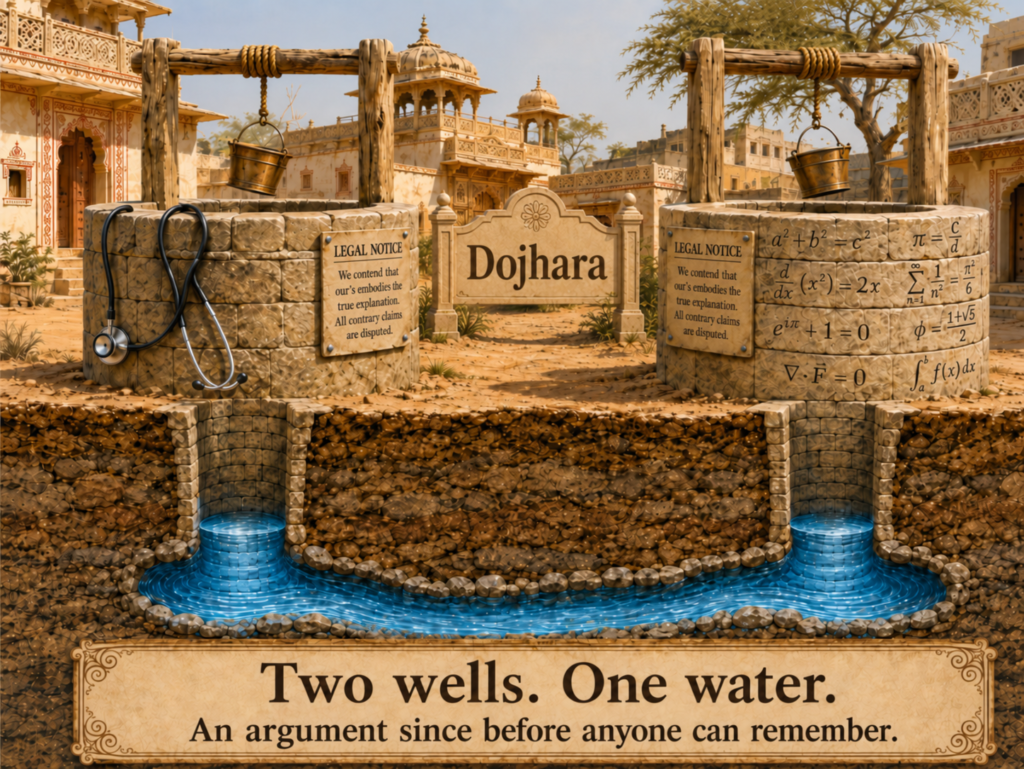
On the founding of the village, told by two of its sons, who agree on everything except the facts.
Ved.
The oldest thing anyone has ever found about Dojhara is a tax receipt.
It dates from the year the Mughal emperor Babur came down through the passes, took India, and it is written in the hand of a revenue clerk who had clearly been riding for some time and wished to be elsewhere. It records a village of two waters, assessed at four goats per annum, and it ends with a phrase that every Dojhara child learns before the alphabet: dispute ongoing. Nobody has ever found a record that says dispute commenced. The argument enters history already in progress, the way a patient enters the examination room already sick, the beginning is somewhere behind us, unrecorded, and all we are ever given is the middle.
I will tell it the way my grandfather told it.
Dev.
I will tell it the way it actually happened, which is different, and shorter, and correct.
Babur conquered India in 1526 and immediately began complaining about it. This is a matter of record. His memoirs list the country’s deficiencies with a thoroughness that would shame a hotel review. No good melons, no grapes, no ice, no proper baths, no candles worth the name.
His clerk, riding south through the sand, found a village that had two of something in a region where most villages could not manage one. He wrote it down and moved on. I have computed the probability that a Mughal revenue officer would record the word ongoing about a dispute that had in fact begun that morning, and the number is small. Ved is right about this, which I concede once per essay, and this was it.
Ved.
There were two brothers.
You will have heard this story before. Every village in India begins with two brothers, the brothers quarrel, one walks east, one walks west, and where they stop, two villages grow. It is the oldest pattern we have. The map of rural India is a map of brothers not speaking.
Dojhara’s brothers were called Hira and Moti, Diamond and Pearl, which tells you what their mother hoped for and how little she got. They came from the south with a herd, a wife apiece, and an argument already mature, and they walked into the desert to find the two springs that gave the place its name. Do jhara. Two springs. The springs were real, once. My grandfather said the old people said the old people had seen them.
And here is the thing that makes Dojhara Dojhara. The brothers reached the springs, and they quarreled, as brothers must, and each turned to walk away from the other in the customary direction. They discovered that the desert extends in every direction for a considerable distance, the nearest other water was eleven days off, and that they were, for all their fury, thirsty.
So they stayed. They dug one well each, forty paces apart, on the two springs. And they built one village between the wells, because it was cheaper, and because their wives had already become friends, which is the first recorded instance of a pattern that has shaped this village’s every generation, and mine.
Dev.
I want to pause on the arithmetic of forty paces.
Forty paces is not far enough to be separate and not close enough to be together. It is the exact distance at which two men can hear each other and choose not to. A mathematician would call it the optimal radius of grievance. Hira and Moti, with no training whatever, discovered a constant that took my profession five centuries to name, and they discovered it by being angry, which is, I have noticed, how most things are discovered.
They also discovered, within the year, that the two wells drew from the same water.
Every child in Dojhara knows this. Pour dye into one well and by morning the it appears in the other. It is the least secret fact in the district and the least mentioned, because if either family admitted it aloud, five hundred years of litigation would have to be explained to a judge, and no lawyer in Rajasthan has ever wanted that.
Ved.
For a generation, the brothers lived in peace, or in the desert version of it, which is peace with commentary.
Then a woman came through.
I should say at once that nobody knows who she was. My family’s version says she was a bride being taken north to her husband’s people and that she stopped for water on the way. Dev’s family says she was a saint. There is a third family in the village, the ones who keep the goats, who say she was a salt trader’s daughter and that her name was Champa, and they say this with such confidence that one suspects them of having made it up recently. She stayed one night. She left the next morning. She is the most consequential woman in the history of the village, and we cannot agree on her name.
What is not disputed is this. She asked for water. Both brothers, who had not spoken to each other in some months, arrived at the same moment with a bucket each, drawn from their own wells, and offered them. She was a courteous woman. She drank from both.
And then she said two words.
Dev.
Ek hi.
I must explain, for American readers, that this is the most dangerous phrase in the Hindi language, and the woman deployed it into a village of two wells with what I can only assume was malicious precision.
Ek hi means the same. It also means only one. The two meanings are not related and cannot be distinguished except by the speaker’s intention and the eyebrow, and the woman left on a camel at dawn with both.
So, did she mean these two waters are the same, a blessing on the whole enterprise, a verdict of equality, a sensible woman noting a fact of geology? Or did she mean only one of these is any good, and if so, which? She had drunk from Hira’s bucket first. Moti’s family has maintained for five centuries that she said ek hi after the second bucket, meaning that the second, Moti’s, was the only one worth drinking. Hira’s family maintains that she said it while returning the first bucket, in a tone of finality, and that the second sip was merely politeness, of which she had a great deal.
I have modeled this. I have assigned probabilities. I have consulted an aunt in Jodhpur who claims to know how such women speak. The honest finding is that the phrase carries an information content of exactly zero bits, it is the only utterance in the language that means, with equal likelihood, everything and its opposite, and that the village has therefore spent twenty generations litigating a quantity that cannot be measured.
I find this magnificent. It is the purest lawsuit in the history of law. There is no evidence, no witness, no document, and no possibility of either side ever being right. It is the mathematical definition of a marriage.
Ved.
Akbar sent a man to investigate and his report survives in a fragment. He records that the plaintiffs were two wells, that the wells were represented by their respective families “as a temple is represented by its priest,” and that neither well attended the hearing. He recommended the matter be dismissed. It was not dismissed, because by then the families had discovered the thing that keeps all long quarrels alive, which is that the quarrel had become more interesting than the thing quarreled about. Nobody in Dojhara has cared about the woman for five hundred years. They care about the case. The case is theirs. She merely started it, and left.
The British came, in time, and a settlement officer in the 1880s, a patient man, by his prose, wrote that he had found the wells of Dojhara in litigation, that he had invited both parties to state their claims, that both parties had submitted identical documents, and that he had “declined to adjudicate between two petitions which, being the same, appeared to have already settled the matter between themselves.” He was wrong, of course. But he was the first outsider to notice the notices, and I have always loved him for it.
Dev.
The identical notices require explanation, and the explanation is my favorite fact about my ancestors.
In the seventeenth century the two families, having exhausted their own literacy, hired a scribe from Bikaner to draft their competing claims. The scribe charged by the document. He was, in the way of scribes, economical. He wrote one notice, “We contend that our’s embodies the true explanation; all contrary claims are disputed,”and sold it to both sides, and rode home, and neither family compared texts for two hundred years, because neither family could read them.
When the documents were finally compared, in my great-grandfather’s time, there was a tremendous scandal, followed by a tremendous silence, followed by the decision of both families to keep the notices exactly as they were, on the grounds that changing one’s own claim after five centuries would look like weakness, and that a claim which is word-for-word identical to one’s opponent’s is, if you think about it hard enough, unanswerable.
Dojhara’s two wells remain in litigation. Both parties have been notified. All contrary claims are disputed.
Dojhara is a fictional place.