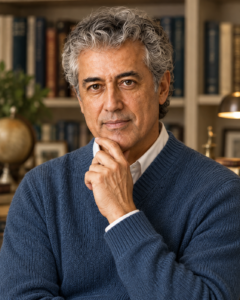
Ved Arogya’s first name means “knowledge.” His last name means “health.” He comes from seven generations of village vaidyas whose remedies often worked and who could never say why. Raised to continue the line, he in a sense betrayed it, and in a sense completed it, by becoming the first Arogya to know the reasons. He has never decided which his grandfather would have considered the greater impertinence: abandoning the remedies, or explaining them.
He was born in Dojhara, a desert village in northwestern India known, to the extent it is known at all, for a lawsuit between its two wells that has outlasted everyone who could explain it. In a village divided by a quarrel, the sick came from both sides, and his grandfather treated them in the order they arrived, which Ved considers his first clinical training. He left young for England, carrying the village’s quieter lesson: a dispute may be eternal, but a fever cannot wait.
In England he became a trauma surgeon, a specialty that teaches two lessons in unequal measure. That the body can survive almost anything, and that “almost” is where doctors live. There, too, he discovered the one finding he has never needed to revise: Angela, a Cambridge schoolteacher who was not impressed by surgeons and said so. In his early thirties he moved to America for bench research, then retrained in internal medicine. A trauma surgeon learns what can be fixed in an hour. An internist learns what can only be tended. Much of what appears here on Tuesdays is an attempt to tell the difference honestly.
Now in his sixties, he believes medicine is half science and half attention: the history taken slowly, the question asked after the patient has finished answering the first one. He writes with evidence where it exists and candor where it does not.
Ved met Dev Ganit at a gathering neither wanted to attend. Both had been delivered there by their wives, and both had positioned themselves near the exit. In a conversation each was trying to end, they discovered they had been born in the same village, two boys sent out of Dojhara by different roads, arriving at the same American afternoon.
Their wives, Angela and Frances, became immediate and permanent friends, a development from which neither man has recovered, and which has cost them, by Dev’s calculation, some two hundred dinners, and by Ved’s, nothing he was using anyway.
Their names, they eventually noticed, are anagrams, which Dev insists is a theorem and Ved records merely as a fact. And so, the arrangement. On Tuesdays, Ved writes about a subject as carefully as he can. On Thursdays, Dev writes about the same subject with what he calls a second opinion and Ved calls a bedside manner in reverse. Ved does not endorse Thursday. He has also never once missed reading it.
He lives with his wife, who spent her career teaching children and now teaches him, chiefly patience, and who has never let him forget that her town had a university before his had a working well. She alone may interrupt him mid-sentence, on the grounds that she has usually reached the diagnosis first. They keep no pets, officially. Unofficially, Dev’s Havanese presents weekly for examinations she does not need and treats he does not admit to carrying.
Ved Arogya is fictional person and Dojhara is a fictional place.